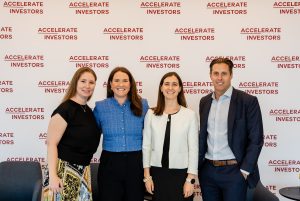
At the Accelerate Investors Summer Investor Insights Summit in Chicago, I moderated a panel titled “Inside the OCIO Playbook” with Hannah Rahill (GEM), Tim McEnery (Cerity Partners), and Anne Duggan (TIFF Investment Management).
The room brought together allocators, investment managers, OCIOs, and—joining for the first time—family offices. Their presence added new perspectives and made the conversation richer. OCIOs occupy a unique vantage point, working across client types, meeting a wide range of managers, seeing many governance structures, and observing how decisions play out over time.
Rather than defining the OCIO model, we focused on what allocators can learn from the way OCIOs diagnose problems, evaluate managers, use scale, and build lasting partnerships.
Here are the key takeaways.
Start with diagnosis, not performance
Performance is often the first concern when organizations question their investment model, but it’s rarely the root issue.
Underlying issues often involve communication, governance, or evolving organizational needs—such as added complexity, shifting liquidity, or balancing long-term goals with near-term demands.
Experienced OCIOs excel at pattern recognition. They distinguish between portfolio, governance, implementation, and relationship problems, each requiring a different solution.
The takeaway: define what “working” means for your organization before evaluating your model.
Choose the right OCIO fit
The OCIO market isn’t one thing. Firms differ in ownership, size, investment philosophy, staffing, implementation, client base, customization, and operational infrastructure. Those differences aren’t cosmetic. They change how a firm actually serves you.
Some offer more flexibility, others emphasize scale or customization. There’s no universally best model—only the right fit for each organization.
Selecting an OCIO is a governance decision—not a simple procurement. The goal is to match the OCIO’s strengths to your organization’s unique needs and challenges.
When does it make sense to go in-house?
One question that didn’t have a clean answer ten years ago was: how big do you have to be before running your own investment office makes more sense than hiring an OCIO?
Consensus has shifted from $750 million a decade ago to nearly $2 billion today, driven by rising operating costs, talent challenges, and the value of scale.
But size isn’t everything. As Tim McEnry put it in a back-and-forth with an allocator from the University of Iowa, “it depends far more on the portfolio, its complexity, and, above all, the governance model. A $2 billion portfolio with a straightforward mandate and a strong internal team may be able to go it alone. A more complex portfolio with limited resources being run by a part-time committee usually shouldn’t.”
Consider the exit: if you anticipate growth and eventual in-house transition, ensure your OCIO’s portfolio design allows for a smooth handoff. Ask about this early.
Managing personalities matters
Managing money is only half the job; managing people and personalities is equally important.
Attention and relationship-building matter. Understanding what each committee member values prevents misalignment and helps partnerships succeed.
As Anne Duggan put it, “A lot of my job is understanding the people on the other side of the table, not just the portfolio. I do a lot of 1:1s for that reason. When the committee inevitable turns over, and you build that understanding again with someone new.” Committee turnover brings new dynamics. Successful OCIOs embrace this as an ongoing part of the job.
When committees help shape the investment process and understand the strategy, they’re more likely to stay disciplined—especially when performance lags.
A good manager still has to fit
For the managers in the room, the most practical stretch of the conversation was about how OCIOs decide whether a manager fits.
OCIOs see an enormous volume of ideas. The hard part isn’t spotting talent. It’s working out whether a strategy has a real role in client portfolios, whether the timing makes sense, whether it’s practical to implement, and whether it suits the specific clients they serve. A manager can be genuinely excellent and still be the wrong addition. The strategy might not fit a client’s liquidity profile. It might duplicate exposure the portfolio already has. It might add complexity a committee isn’t set up to oversee. It might be a great idea at the wrong time.
Anne Duggan was direct about this. As she put it, “TIFF has a view, and when a strategy doesn’t fit, the best thing an OCIO can do is be honest.” For managers, that’s a useful reminder: the most productive conversations with OCIOs get past pedigree and past performance to the factors that actually determine fit: portfolio role, client relevance, operational fit, and timing. For allocators, it’s the same lesson from the other side. The job is deciding which good ideas actually belong in the portfolio.
Where AI is actually useful right now
No 2026 investment conference is complete without an AI conversation. The interesting version is the small, practical one: where is AI already making the work better?
Often it’s the unglamorous stuff. Notetaking is the obvious one. Hannah Rahill mentioned that GEM has been through a handful different AI notetakers and is currently using Granola. The applications that stick tend to be the ones that quietly reduce friction: speeding up document-heavy work, helping teams prep for meetings, keeping information organized.
The useful question for an allocator is how an OCIO is using AI to make its work faster and more consistent, and where it still insists on human judgment. AI can improve a first draft, a summary, a workflow. Judgment, context, and fiduciary accountability stay human.
Some things you can only learn over time
A playbook only gets you so far. Some parts of a relationship can’t be assessed at the start.
As Hannah Rahill put it, “Risk tolerance takes time, and sometimes a drawdown, to understand.” You find out how a partner communicates when markets are ugly. You find out whether a manager does what they said they would do. You find out how a committee behaves under stress, and whether a firm’s stated philosophy actually shows up in its decisions.
That knowledge only comes with repetition: hard conversations, full market cycles, the moments when expectations have to be reset. It’s why long-term alignment carries so much weight in this decision. You’re choosing a partner you can work with through changing markets, changing stakeholders, and changing organizational needs.
The playbook is judgment
We called the panel Inside the OCIO Playbook, but what the hour kept circling back to was simpler: the real playbook is a way of thinking.
It starts with diagnosis. What is the organization actually trying to solve? From there it’s context: how governance, liquidity, operations, and mission shape the answer. It leans on real manager judgment about which good ideas actually belong. And it’s earned through experience, the pattern recognition that only comes from years of real decisions with real institutions.
For a fiduciary, that’s the part worth holding onto. The OCIO decision is, more than anything, a bet on judgment: on choosing a partner whose way of operating fits your organization over time. The strongest relationships hold up because the committee and the OCIO make good decisions together, in both good and bad markets. That, in the end, is what produces good returns.